
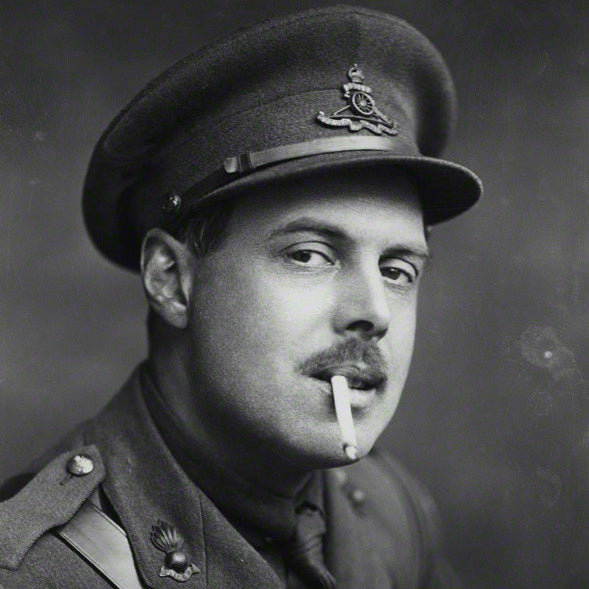
Meet Wyndham Lewis – Britain’s Vorticist Firebrand

Few twentieth‑century British artists cut as provocative a figure as Percy Wyndham Lewis. Painter, novelist, polemicist and founder of Vorticism, he spent his career sharpening modernism’s angles and its arguments alike. Born at sea off Nova Scotia in 1882 and trained at London’s Slade School of Fine Art, Lewis blended the hard geometry of Cubism with the machine‑age dynamism of Futurism to forge something unmistakably his own.
Vorticism: ‘blasting’ the status quo
In 1914 Lewis and poet Ezra Pound launched Blast, a brash magenta‑covered magazine whose manifesto “blasted” Edwardian complacency and “blessed” the new vitality of the city. The accompanying Vorticist paintings – all jagged forms and pulsing colour planes – pushed British art head‑long into the modern era. It was during this burst of creative energy that Lewis produced Composition in Red and Mauve (1915), the work celebrated in the print above.
War artist and chronicler of modern life
The First World War interrupted Vorticism’s momentum, but it deepened Lewis’s vision. Serving as an artillery officer and later an official war artist, he captured the mechanised horror of the Western Front in works such as A Battery Shelled (1919). That same clear‑eyed graphic punch went on to infuse his satirical novels (Tarr, The Apes of God) and razor‑sharp essays on culture and politics.
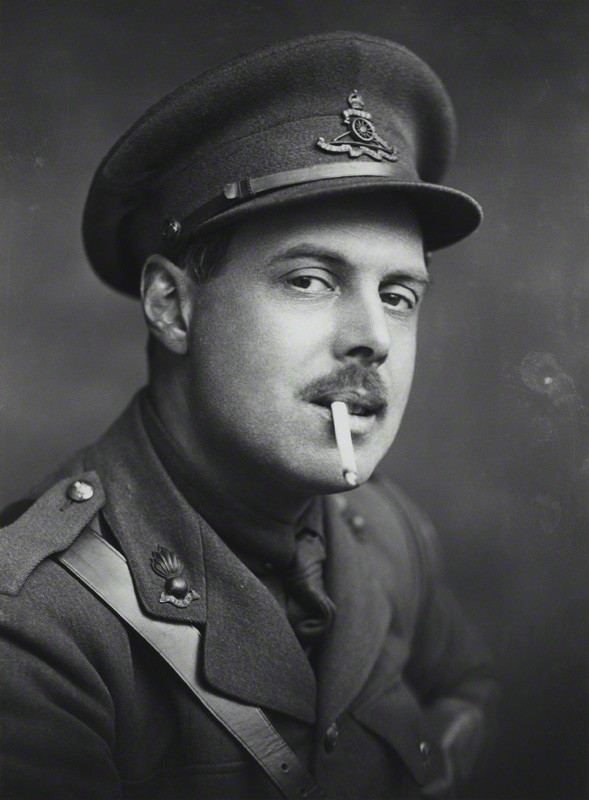
Wyndham Lewis in uniform, 1917. Public‑domain photograph by George Charles Beresford.
Why Lewis still matters
- Architect of British modernism – Vorticism gave Britain its first home‑grown avant‑garde, distinct from French Cubism or Italian Futurism.
- Multidisciplinary maverick – Lewis wrote, painted, edited journals and designed exhibitions, insisting art embrace every tool of the new century.
- Unsparing critic – his essays dissect modern culture with wit and surgical precision, influencing thinkers from Marshall McLuhan to T. S. Eliot.
Today his angular compositions feel as fresh as the day they rattled Bloomsbury’s teacups. For anyone exploring early British abstraction – or just after a striking hit of geometric colour for the wall – Lewis remains essential viewing.